

The Role of AI in Construction Estimation: Assistance Over Replacement
June 02, 2026
There is a lot of discussion today about AI and how it may change jobs in the future. Many people worry that technology will replace human workers and take over entire industries. Because of this, it’s normal for professionals to feel uncertain about what lies ahead.
However, construction estimating tells a different story. In this field, AI is not replacing estimators it is helping them work smarter and faster.
We recently worked with Byron Smith from the YouTube channel Learn About Construction to explore how AI is really being used in the industry. His message is clear: AI should be seen as a helpful tool and a partner for estimators, not a replacement for their skills and experience.
The Myth of AI vs. The Reality of Partnership
When people hear the word “automation,” they often assume it means jobs will disappear. But construction works very differently from industries that repeat the same process every day. Every construction project is unique, with different requirements, challenges, and conditions.
There are also important things AI still cannot fully do.
Can AI truly understand the purpose behind a design?
Can it review specifications and notice missing scope details?
Can it detect practical construction issues the same way an experienced estimator can?
Not completely.
AI is very good at handling large amounts of data and speeding up tasks, but it cannot replace real-world experience and human judgment. It does not think like an experienced professional or understand project relationships and on-site realities the way people do.
That’s why AI in construction should be viewed as a support tool. The best AI solutions are designed to help estimators and construction teams work more efficiently—not replace their expertise.
How the Partnership Works: Speed Meets Strategy
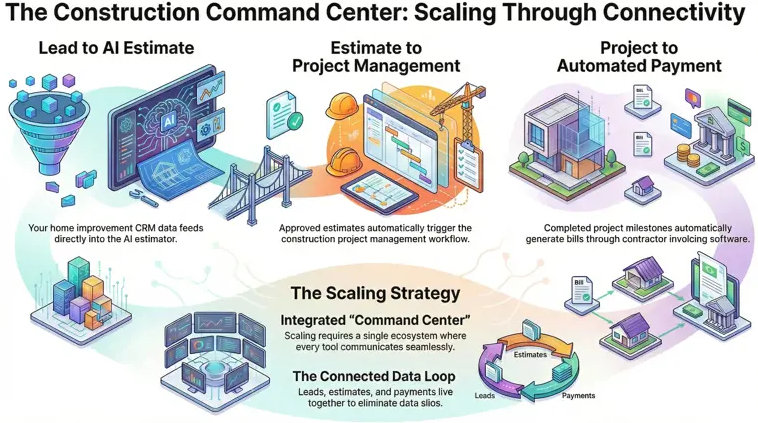
So, if AI isn't doing the thinking for you, what is it doing? It’s handling the grunt work.
Estimating involves a massive amount of repetitive tasks. Counting doors, measuring linear feet of walls, and marking fixtures is necessary work, but it’s not where you add value. Your value lies in strategy, pricing, and risk assessment.
In the video, Byron breaks down how this partnership works in real life using Takeoff Boost:
Step 1: Upload the Drawings
You start the process just like you always do. You get your set of plans and load them into the software.
Step 2: AI Does the Heavy Lifting
Instead of you manually clicking and dragging your mouse for hours, Takeoff Boost scans the drawings. In minutes, it identifies and quantifies key elements like walls, doors, windows, and fixtures. It does the tedious counting and measuring at a speed no human can match.
Step 3: Review, Verify, and Refine
You review the AI's work. You verify the counts, check the measurements, and apply your specific knowledge to refine the estimate.
Why You Need an AI Advantage
You might be thinking, "I've been estimating by hand or with basic digital tools for years. Why change now?"
The answer is simple: the job's getting harder. Deadlines are tighter. Margins are thinner. Competition is fiercer. The old ways aren't fast enough to keep up.
Estimators who embrace AI gain three distinct advantages:
Faster Takeoffs: By automating the initial counting and measurement process, you can prepare bids much faster and take on more projects without overloading your team.
Fewer Errors: Manual takeoffs are prone to mistakes, especially after long hours of repetitive work. AI provides a consistent baseline of data, helping reduce the risk of costly errors and omissions.
More Time for Strategy: The biggest advantage is the time you save. Instead of spending hours on repetitive takeoff work, you can focus on accurate pricing, subcontractor coordination, client relationships, and overall bid strategy.
The Future Belongs to the Empowered Estimator
A popular saying in the tech world fits the construction industry well: “AI won’t replace your job, but someone using AI might outperform those who don’t.”
The most successful estimators are not replaced by technology. Instead, they use technology to work faster, make smarter decisions, and improve their overall efficiency. When AI takes care of repetitive tasks, estimators can focus more on what truly matters—winning projects, solving problems, and delivering successful construction work.

Comments
No comments yet. Be the first to comment!