blog
10 Game-Changing Innovations Transforming the Construction Industry

April 29, 2026

Construction is advancing at a rapid pace, with increasing resources being invested in new technologies to modernize the industry. These investments are delivering real results—studies indicate that digitally advanced companies can achieve up to 48% higher revenue and 15% greater net margins compared to their peers, including within the AEC sector.

However, a gap still exists. Around 25% of businesses overestimate their data capabilities, while nearly 80% of construction firms remain at beginner or early stages of data maturity. This highlights both the challenges and the immense potential for growth through better use of technology.

As digital tools continue to reshape the landscape, construction companies are finding new ways to improve efficiency, tackle complex challenges, and stay competitive. With the pace of innovation accelerating, the industry is entering an exciting phase of transformation. Here are 10 key innovations set to shape the future of construction.

Top 10 Construction Innovations:

  • 1- AI & Machine Learning
  • 2- Resource & Workforce Management Software
  • 3- 3D Printing
  • 4- XR, AR, VR, and the Metaverse
  • 5- Sensor Data
  • 6- Digital Twins
  • 7- Truly Connected Construction
  • 8- Takeoff & Estimating Tools
  • 9- BIM Beyond Design
  • 10- Robotics

  • Introduction: The Changing Face of Construction
  • The construction industry is undergoing a significant shift, driven by the growing adoption of advanced technologies and innovative building materials. Approaches such as offsite and modular construction, along with modern delivery models like design-build, are reshaping traditional practices. These developments are making it easier for project teams to plan, visualize, and execute projects with greater efficiency.

    Technologies that once seemed futuristic such as virtual reality, augmented reality, and digital twins are now commonly used on job sites, enhancing collaboration and enabling faster, more informed decision-making. As the industry continues to evolve, particularly with the rise of AI, keeping pace with these trends is essential for companies aiming to stay competitive and deliver high-quality results.

    The Benefits of Embracing Construction Technology

    Adopting modern construction technology brings significant benefits to businesses by improving efficiency and overall performance. Tools like AI and Building Information Modeling (BIM) help streamline workflows, reduce manual errors, and enhance project productivity.

    These technologies are especially valuable for large and complex projects, where better coordination and precision are essential. Advanced solutions enable stronger collaboration, optimize workforce utilization, control costs, and support on-time project delivery. In the long run, embracing innovation allows construction companies to stay competitive and adapt to an evolving industry landscape.

    Top 10 Construction Technology innovations:

    1. AI and Machine Learning

    Efficient workflows are critical for success in the AEC industry, but construction projects are often complex, leading to disconnected and manual processes. Key areas like communication, data management, and transparency frequently pose challenges. AI is helping address these gaps by improving coordination, enhancing data use, and increasing visibility—ultimately boosting productivity and profitability. In fact, the Construction Management Association of America (CMAA) estimates that AI could increase industry profits by up to 71% by 2035.

    Machine learning is further strengthening workflows by enabling smarter decision-making through predictive analytics. By analyzing both current and historical project data, companies can better anticipate outcomes, reduce risks, and plan more effectively. Studies show that data-driven construction leaders are seven times more likely to adopt AI and machine learning, highlighting its growing importance.

    These technologies are especially valuable in managing complex projects, helping teams identify risks early, seize opportunities, and focus on higher-value tasks. Integrating AI and ML into construction processes leads to more efficient project management and improved results. For example, companies using AI-powered predictive tools have reported notable gains in quality, safety, and time efficiency, demonstrating the real-world impact of these innovations.

    2. Resource and Workforce Management Software

    Labor and resource management make up a large portion of construction costs, so handling them efficiently is critical. Workforce management software helps companies streamline operations, allocate resources effectively, and avoid delays or unexpected expenses. Project managers and site supervisors rely on these tools to control budgets, maintain schedules, and keep projects on track.

    Today’s platforms bring greater efficiency through real-time data and analytics, enabling teams—whether on-site or remote—to coordinate across multiple projects. Features like predictive tracking, forecasting, and mobile-first interfaces reduce manual work and improve decision-making.

    Tools such as Bridgit Bench and Riskcast support better planning by tracking workforce needs, capturing field data, and comparing actual performance with project plans. By using these insights, construction firms can assign the right resources at the right time, improving productivity and adapting more effectively to changing market conditions.

    3. The Next Wave of 3D Printing

    3D printing is no longer just an emerging idea in construction—it’s steadily becoming a practical and scalable solution. As the technology matures, it is moving closer to mainstream adoption, offering new ways to improve efficiency and creativity in building projects.

    When implemented effectively, 3D printing can accelerate construction timelines, reduce material waste, and lower overall costs compared to traditional methods. It also opens the door to more complex and customized designs that are difficult to achieve with conventional techniques.

    Its applications are expanding rapidly—from creating detailed architectural elements like facades to producing building components, fixtures, and even furniture. This is especially valuable in situations with supply chain disruptions or in remote locations, where materials can be produced on demand instead of waiting for delivery.

    As the industry continues to evolve, 3D printing is expected to play a bigger role in improving quality control, addressing labor shortages, and enabling innovative construction solutions.

    4. XR, AR, VR, and the Metaverse

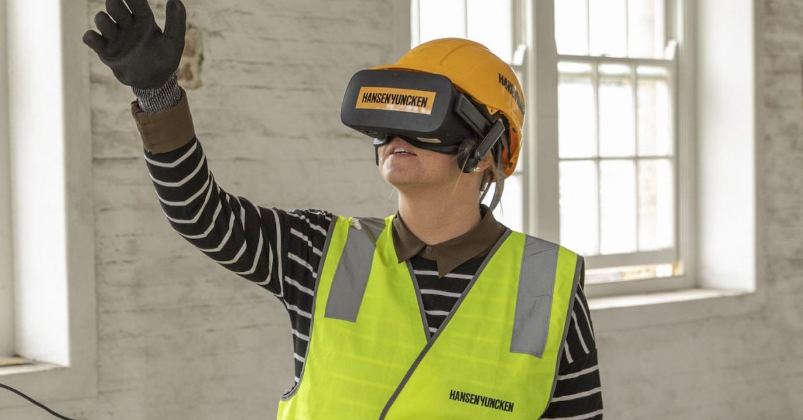
    Extended Reality (XR) is an umbrella term that includes immersive technologies like Virtual Reality (VR), Augmented Reality (AR), and Mixed Reality (MR). These tools, accessible through devices such as smartphones and VR headsets, allow users to interact with digital environments in real time.

    In construction, VR is increasingly used for site surveys and project visualization, helping teams collaborate earlier and more effectively. AR and VR also support remote inspections, enabling teams to review sites safely, identify issues faster, and reduce costs.

    These technologies are transforming AEC workflows by improving design reviews, issue tracking, and spatial understanding. Immersive platforms now allow teams to explore projects at full scale, making it easier to detect errors and refine plans before construction begins.

    As adoption grows, XR is redefining how construction teams collaborate and solve problems, creating more efficient, interactive, and accurate project workflows.

    5. Sensor Data

    Monitoring key elements like workforce, equipment, and job sites is essential for efficient construction operations. Accurate tracking supports better planning, smoother workflows, and improved compliance with safety standards.

    With the rise of sensors and IoT technology, managing these moving parts has become much easier. Modern solutions allow companies to track site conditions, monitor equipment performance, follow materials across the supply chain, and enhance worker safety—all in real time.

    Advanced use of sensor data also enables predictive insights. By analyzing usage patterns and performance data, companies can anticipate potential issues, schedule maintenance more effectively, and reduce downtime.

    As adoption grows, sensor-driven insights are helping construction firms operate more efficiently, improve safety, and make smarter, data-driven decisions.

    6. Digital Twins

    Digital twins are virtual representations of physical assets, combining data, systems, processes, and real-world performance into a single digital model. In construction, creating a digital twin early in a project helps teams better understand and manage a building throughout its lifecycle.

    This digital replica allows teams to analyze, test, and optimize structures before and after construction. It supports improved efficiency, stronger safety planning, reduced risks, and higher overall quality. Digital twins also extend the value of BIM by connecting real-time data directly to physical assets.

    With nearly 80% of a building’s value realized during operations, digital twins provide critical insights for maintenance, performance tracking, and long-term planning. They help owners monitor key metrics, meet sustainability goals, and predict future outcomes based on real-world data.

    As construction projects become more complex, digital twins are playing a key role in improving asset management and enabling smarter, data-driven decisions across the entire project lifecycle.

    7. Truly Connected Construction

    Simplicity may not sound groundbreaking, but it’s at the core of some of the most effective innovations. When data, workflows, and technologies are fully integrated, they become far more powerful and easier to use.

    In construction, however, disconnected systems and data silos are still common, often slowing down projects and creating inefficiencies. With large volumes of data and multiple stakeholders involved, having a single, reliable source of information is essential.

    Connected construction addresses this by bringing together data, processes, and teams into one unified environment. By integrating workflows across all project stages, it improves coordination, enhances decision-making, and streamlines overall project management.

    Using centralized platforms, companies can access all project data in one place from early design to execution reducing complexity and enabling teams to make faster, more informed decisions.

    8. Advanced Takeoff and Estimating Tools

    Traditional spreadsheets are no longer enough for accurate takeoffs and cost estimation. Modern preconstruction tools are transforming how contractors handle bidding, helping them improve accuracy, reduce risks, and focus on winning more projects.

    Today’s takeoff and estimating solutions are cloud-based, allowing teams to access and manage project data from anywhere. By connecting data and teams on a single platform, these tools enhance collaboration and minimize errors that can lead to delays during construction.

    With features like automation and 3D visualization, contractors can work faster, generate more precise estimates, and submit more competitive bids. Overall, advanced takeoff and estimating tools help streamline preconstruction processes and improve project outcomes.

    9. BIM Beyond Design

    Building Information Modeling (BIM) is widely known as a design tool, but its value extends far beyond that phase. When shared between design teams and field crews, BIM becomes a powerful communication tool that simplifies coordination and improves project understanding.

    Using BIM directly in the field helps preserve valuable data that is often lost when models are converted into static formats. This leads to better visibility, stronger collaboration, and reduced rework costs.

    As the industry evolves, BIM is becoming a standard requirement, with a growing focus on using its data for deeper insights, improved transparency, and smarter decision-making. Expanding BIM beyond design allows teams to stay aligned, enhance safety, and work more efficiently throughout the project lifecycle.

    With the integration of AI, BIM is unlocking even greater potential enabling automation, advanced data analysis, and more informed decisions. Today, BIM is no longer just a design tool but a comprehensive solution for improving quality and collaboration across construction projects.

    10. Robotics

    Robotics is becoming an important part of the construction industry’s future, offering new ways to improve efficiency, productivity, and safety. However, adoption can be challenging due to high initial costs and a lack of specialized skills within teams.

    While many robotic solutions are still in early stages or pilot projects, their potential is clear. To ease adoption, companies can begin with more established technologies like drones or prefabrication, while also investing in training and partnerships to build expertise.

    There is growing interest among workers to engage with these innovations, especially as they reduce physical strain and improve job site safety. Robotics can take over repetitive or hazardous tasks, allowing workers to focus on higher-value activities.

    As collaboration between construction firms and technology providers increases, robotics will continue to evolve into more practical, tailored solutions. Ultimately, embracing robotics can help companies streamline workflows, optimize resources, and deliver projects faster and more safely.

    Moving Innovation in Construction Forward

    The construction industry is rapidly transforming before our eyes. These 10 innovations are set to play a crucial role in driving efficiency, improving performance, and shaping the future of the industry.


  • Comments

    No comments yet. Be the first to comment!

    Leave a Coment